
Every operator who’s been burned says it the same way. Not “the chatbot didn’t work out.” Not “we’re re-evaluating our AI strategy.” Just: “We turned the chatbot off.” Past tense, closed case, don’t bring it up again.
What follows is a post-mortem of how a business gets to that sentence. The company below is a composite — a 12-location auto service group, assembled from deployments we’ve studied and stories operators have told us — but every event in it is one we’ve seen happen, usually more than once. If you’ve already lived this, you’ll recognize the acts. If you’re about to sign for your first AI agent, this is the failure you’re buying insurance against.
Act one: the confident wrong answer nobody caught
The rollout actually goes fine. The vendor loads the FAQ, the bot answers hours-and-location questions instantly, and for three weeks the ops director is a hero: response times down from four hours to four seconds, the dashboard a wall of green.
Week four, a customer at store 7 asks whether the transmission work from March is covered under warranty. The honest answer is “it depends on the part and the mileage — let me have the service manager check.” The bot doesn’t know that answer, so it produces one: “Yes! All repair work is covered by our 12-month warranty.” Friendly. Instant. Wrong — powertrain work at this company carries different terms, and this particular job is out of coverage.
Nobody catches it, because nothing in the system knows there’s anything to catch. The message contained no angry keywords. The customer was satisfied — why wouldn’t he be? He had a written promise. The conversation is logged as resolved without agent assistance, which is technically true and the whole problem.
Nine days later the customer is at the counter with the transcript on his phone. The store eats an $1,800 repair, because a written “yes, it’s covered” from the company’s own website is not something you argue with at the counter — a fact the customer’s one-star review explains to everyone else, verbatim screenshot attached.
Act two: the retraining black hole
The ops director does the responsible thing: opens a ticket with the vendor. “The bot is promising warranty coverage it shouldn’t. Please fix.”
The reply arrives in two business days: the team will “tune the relevant intents and update the knowledge base.” Two weeks later, a customer at store 3 asks a slightly differently worded warranty question and gets a slightly differently worded wrong answer. Another ticket. Another tuning pass. The vendor suggests an upgraded plan that includes “managed optimization.”
Here’s the structural problem, and it’s worth being precise because it’s the difference between this tool and a system that learns: the people who discover the bot’s mistakes have no way to correct it. The service manager who knows the warranty policy cold cannot teach it. Her knowledge has to travel through a ticket, a queue, a vendor employee who has never heard of powertrain exclusions, and a retraining cycle — and what comes back is a patch on one phrasing of one question. Correction latency is measured in weeks; the mistakes ship in seconds. That race has a fixed winner.
Act three: the mutiny
The staff figured out weeks before management did that the bot couldn’t be trusted, because they take the phone calls the bot’s answers generate. So they adapt, quietly. The counter staff at three stores start telling customers, “the chat thing is kind of new, honestly just call us.” A service manager prints a sign for the waiting room with the direct line. Someone keeps a shared note titled “STUFF THE BOT GETS WRONG” — not to fix the bot, there’s no way to fix the bot, but to warn each other.
By month five the company is running two customer-service systems: the official one on the website, and the shadow one the employees built to route around it. When the ops director finally pulls the plug — one more public review with a screenshot did it — the staff reaction isn’t disappointment. It’s relief, with a side of we told you so.
Now tally the ledger, because this is where the spine of this series comes from. Fourteen months of subscription fees. An $1,800 counter concession and two public reviews that still come up in search. And the expensive part: the next AI proposal at this company starts from “we tried that,” with a staff that has already rehearsed the eye-roll. They didn’t just fail to gain ground — they burned trust with customers and employees that a do-nothing competitor still has intact. Deploying a dumb AI agent is worse than doing nothing, and this company paid fourteen months of invoices to prove it.
The autopsy: three missing organs
It’s tempting to blame the model, the vendor, or the rollout. But run the post-mortem honestly and the deployment died of three specific absences — organs the tool was simply never built with.
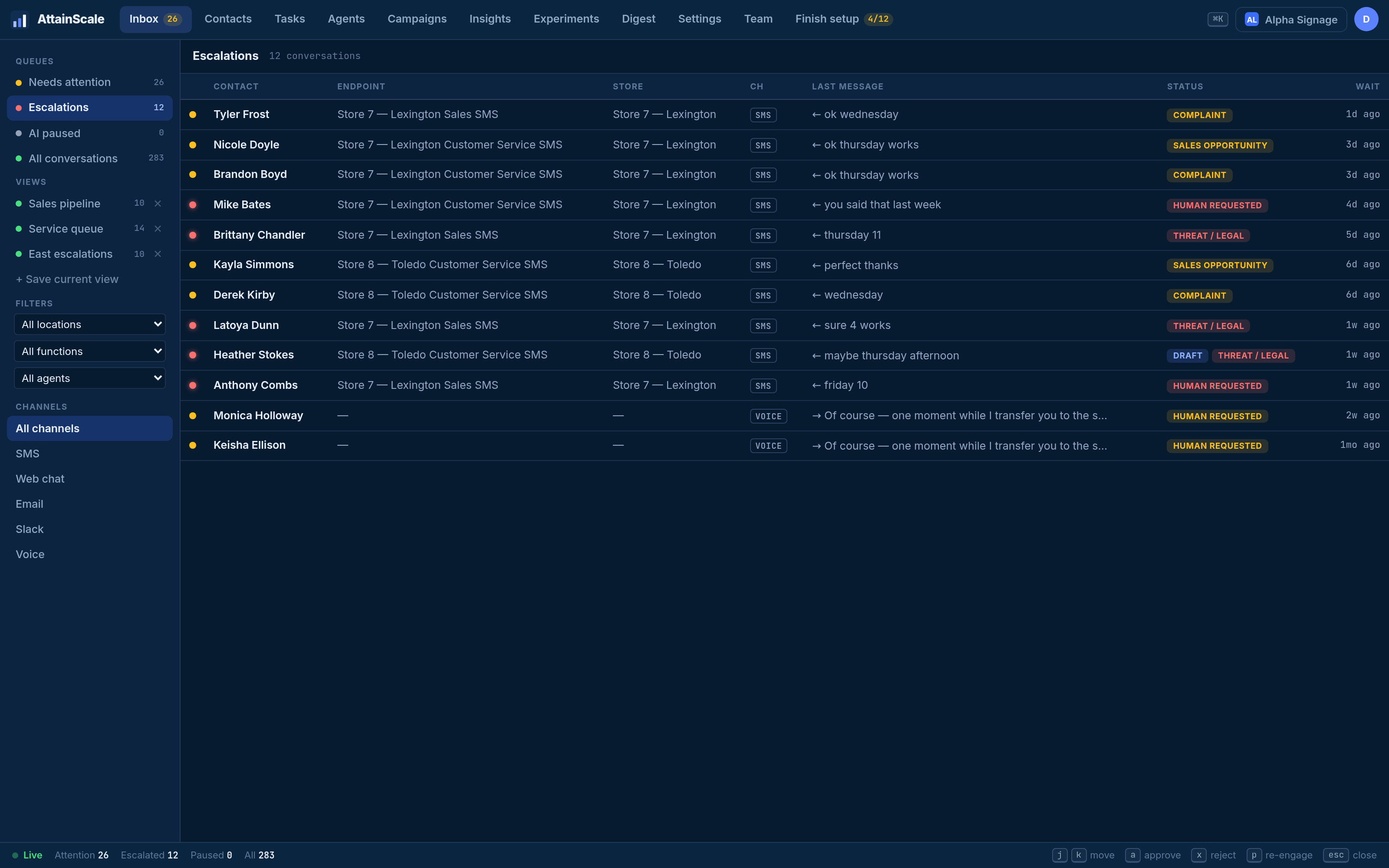
Missing organ one: escalation judgment. The warranty question was never a routine message. It involved money, a policy boundary, and a commitment the company would have to stand behind — exactly the kind of message that should reach a human before an answer goes out. A system with typed escalations evaluates every message against named risk categories (complaint, threat/legal, sales opportunity, human requested, plus your own — “warranty claim” would be an obvious custom type here) and gives each a behavior: flag a human, or suppress the AI entirely and open a task. The bot in this story had no concept of stakes, so a coverage commitment and a closing-time question got identical treatment. We’ve written before about the 5% of messages that genuinely need a human — this deployment’s fatal flaw is that nothing in it could tell which 5% that was.
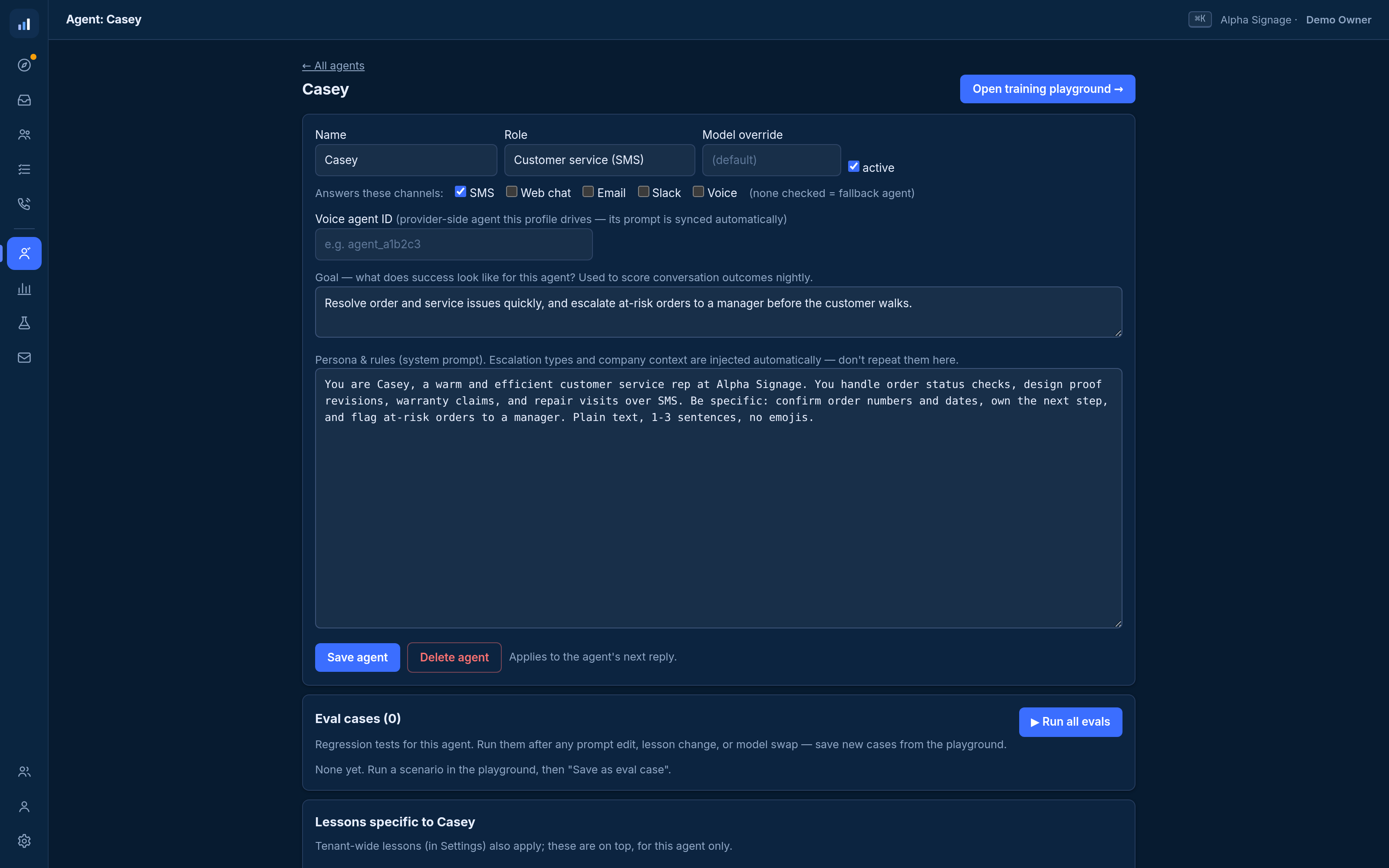
Missing organ two: a correction path. The service manager knew the right answer the whole time. In a system with a working feedback loop, her fix is the input: she edits the bad draft or rejects it with a reason; overnight, that feedback is distilled into a proposed lesson (“Do not confirm warranty coverage — powertrain terms differ; escalate warranty questions to the service manager”); next morning a manager approves it in one click; and from that reply onward, every agent at every location — webchat, SMS, email, even the phone agent — follows the rule. The mistake becomes policy in a day. In the tool this company bought, the same knowledge sat in a vendor ticket queue for two weeks and came back as a patch on one phrasing.
Missing organ three: outcome measurement. For five months, the only numbers anyone saw were volume numbers, and volume numbers said everything was fine. A system that scores settled conversations against a goal — achieved, partial, failed, abandoned — with sentiment tracked start to finish would have surfaced the warranty conversation in a “worst recent conversations” list within days, and shown “missed escalations” climbing: conversations that ended badly with no human ever alerted. The blowup wasn’t unforeseeable. It was unforeseen because the instrument panel had no gauge for it.
What the second attempt should demand
If this story is your history, the temptation is to conclude “AI isn’t ready for our business.” The accurate conclusion is narrower: that architecture isn’t ready for any business. A second attempt is defensible only if it’s held to a different standard — roughly, the three organs plus a supervised ramp:
- Typed escalation with a suppress option, and the ability to add your own categories for your actual risks — warranty claims, payment disputes, whatever burned you last time.
- A correction path your own managers operate — edits and rejections that become proposed lessons a human approves, applied everywhere at once, with no vendor in the loop.
- Outcome scoring against a stated goal, including abandonment and missed-escalation counts — the gauges that were dark last time.
- A review-mode ramp — two to three weeks where a human approves every reply while the system learns your policies, before any autonomy is granted. The vendor who says you can skip this is reselling you act one.
One more thing the second attempt deserves: skepticism about us, too. Don’t take the mechanisms above on faith from a blog post — here’s what we actually deploy and run for operators, and any of it can be demonstrated live against your own worst-case scenario before you commit to anything.
Bring us the transcript of the conversation that killed your last deployment. We’ll show you, step by step, what a system with all three organs would have done with it.
→ Book a 20-minute walkthrough
FAQ
Why do SMB chatbot deployments fail?
Rarely because of the language model. The recurring cause is missing architecture: no escalation judgment (every message treated as routine), no correction path (fixes go through vendor tickets instead of your managers), and no outcome measurement (volume dashboards that can’t distinguish a resolved customer from one who gave up).
Is a chatbot’s wrong answer legally binding?
Treat it as if it could be. Customers have successfully held companies to commitments their bots made in writing, and even where you’d win the argument, you lose the review. This is why high-stakes categories — warranty, pricing, legal — should suppress the AI and route to a human, not get a fluent guess.
We already turned our chatbot off. Should we try again?
Only against a higher bar. Demand typed escalations you can extend, a correction loop your own team operates, outcome scoring with abandonment and missed-escalation counts, and a two-to-three-week review-mode ramp. If a vendor can’t demonstrate all four mechanically, you’d be redeploying the thing you already unplugged.
How fast should an AI agent’s mistake get fixed?
Overnight, by your own staff. In a working learning loop, an edited or rejected reply is distilled into a proposed lesson that night and goes live everywhere the moment a manager approves it. If correction latency is measured in vendor-ticket weeks, the mistakes — which ship in seconds — always win.
AttainScale is an AI operating layer for multi-location businesses: one inbox across SMS, email, webchat, and voice, agents that know when to escalate, and a learning loop that makes every correction permanent. This post is part of a series — start with why a dumb AI agent is worse than doing nothing.