
Somewhere in your peer group — the operators you trade notes with at association meetings — someone is about to sign for an AI agent this quarter because doing nothing feels like falling behind. We sell AI agents for a living, and we’re going to say the quiet part anyway: deploying a dumb AI agent is worse than doing nothing.
“Nothing” has a failure mode you already understand. When a customer texts your service line and nobody answers, you lose that customer the old-fashioned way: one at a time, visibly, with a human somewhere in the chain who knows the ball got dropped. It’s slow, it’s expensive, and it’s fixable, because someone owns the miss.
A dumb agent inverts all three properties. It loses customers at scale — hundreds of conversations a day, every one carrying your company’s name. It loses them silently, because the customer got an answer; it was just the wrong one, delivered politely. And it loses them while reporting success, because the dashboard counts conversations handled, and it handled every single one.
What “dumb” actually means
Not the model. The language models inside most of these tools are broadly similar, and most of them write a perfectly fluent sentence. “Dumb” is an architecture problem, and it’s precise. A dumb agent has four specific incapacities:
- It can’t tell routine from critical. “What time do you close?” and “my brakes failed after your repair and my lawyer wants your insurance information” arrive in the same pipe and get the same cheerful treatment. There is no concept of stakes anywhere in the system.
- It guesses when it’s unsure. Ask about a price it doesn’t know, a policy edge case, a warranty boundary — it produces a confident answer, because producing confident answers is the one thing language models are relentlessly optimized to do.
- It can’t be corrected. When it gets something wrong, your only recourse is a support ticket to the vendor. The mistake it made on Tuesday is fully available to it on Wednesday.
- It measures volume, not outcomes. It can tell you it handled 10,000 conversations. It cannot tell you how many of those customers got what they came for, went silent mid-thread, or left angrier than they arrived.
Any one of these would be a flaw. All four together are a machine for converting your customer goodwill into vendor invoices.
Four ways it costs you more than silence
Damage one: trust erosion at scale. Run the arithmetic on your own volume. Eight locations, 60 inbound messages a day each, and a wrong-answer rate of just 4% — a rate most chatbot deployments would envy — is 19 confident mistakes per day, 134 per week, every one signed with your brand. Silence reads as “they’re busy.” A wrong answer reads as “this company doesn’t know its own business.” Customers forgive the first far longer than the second, and no human on your payroll ever sees most of them happen.
Damage two: the blowup. Most wrong answers cost you quietly. A few cost you loudly, because the confident guess landed on money or law: the bot that tells a customer their repair is covered under warranty when it isn’t, quotes a price a location can’t honor, or keeps chirping helpfully at someone who has already said the word “attorney.” Those become the one-star review that quotes the chat transcript verbatim, the chargeback dispute where the customer has your bot’s promise in writing, the letter your insurance agent asks you about. A human employee might make the same mistake once. The bot makes it every time the question appears, at every location, until someone notices — and nobody is looking.
Damage three: your staff learns to route around it. Your people find out about the bot’s mistakes before you do, because they take the phone calls that follow. So they adapt: the front desk starts telling customers “honestly, just call us — don’t use the chat.” A manager starts keeping her own spreadsheet of things the bot gets wrong, not to fix it — there’s no way to fix it — but to warn the new hire. You are now paying for the tool and the workaround. And you’ve spent something scarcer than money: the next time you bring your team a system that actually works, the pitch opens against “we tried that.”
Damage four: the false-comfort dashboard. This is the one that makes the other three durable. The dumb agent’s reporting says it’s winning: conversations handled, up. Deflection rate, up. Average response time, seconds. Deflection is an especially corrosive metric — a customer who asked twice, got nonsense twice, and gave up is counted as a success, because they never “needed” a human. The dashboard doesn’t just fail to show the damage; it actively tells you not to look. Doing nothing at least leaves you accurately worried.
What “doing nothing” quietly preserves
Let’s not romanticize the status quo. Doing nothing means slow responses, missed after-hours messages, and your best people spending their day on triage — we wrote a whole piece on what that costs, and the number is ugly.
But the status quo preserves one asset a dumb agent destroys: human judgment at the point of contact. An employee who doesn’t know the answer says “let me check” instead of inventing one. An employee smells the lawyer in the second sentence and changes register. An employee’s mistakes are singular — they don’t replicate identically across 400 conversations. And when an employee drops a ball, there’s a name attached; you can coach, reassign, or apologize. Failure stays bounded, visible, and owned.
That’s the actual bar for deploying an AI agent. Not “better than zero.” Better than bounded, visible, owned failure. Most of what’s sold to multi-location businesses doesn’t clear it.
The deployability test: four questions
The good news is that “dumb” is testable before you sign anything. Each of the four incapacities has a mechanical fix, and a vendor either has the mechanism or doesn’t. Ask these four questions and insist on being shown — not told — the answer.
1. Does it know when to stop? The agent should evaluate every message against named categories of risk and opportunity — a complaint that’s escalating, a legal or safety threat, a sales opportunity above the routine, a customer asking for a person — and each category should carry its own behavior. In AttainScale these are typed escalations: a complaint flags a human with the reason attached, while a threat/legal escalation suppresses the AI entirely and opens a task for whoever handles it. If the vendor’s answer involves keyword triggers, that’s a no.
2. Does it hold when it’s unsure? Before an autonomous reply goes out, something should be checking it. AttainScale scores every autopilot reply 0–100 with a judge briefed to score low when the draft guesses facts, promises anything uncertain, or mishandles an upset customer. Below your threshold, the reply is held for review with the reason shown; if the judge itself is unavailable, the reply holds anyway. The gate fails safe. (Guessing deserves its own post — the confidence test is where we take it apart.)
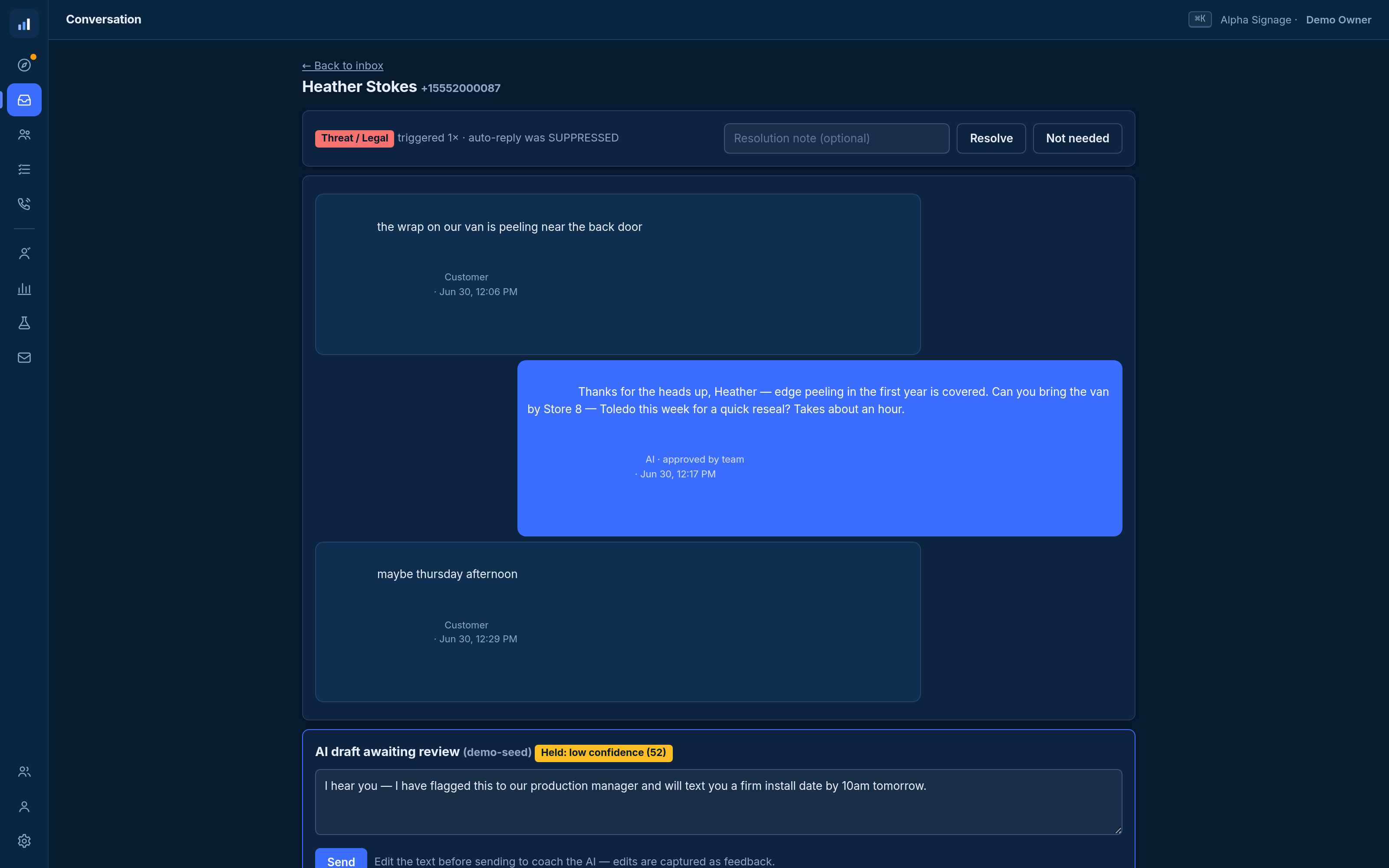
3. Does correction stick? When your manager fixes a wrong reply, where does the fix go? The right answer is: into the system, permanently. In AttainScale, every edited or rejected draft is feedback; nightly, the batch is distilled into proposed lessons; a manager approves each one with a click; the approved lesson is in the very next reply’s instructions — on every channel, at every location, including the phone agent. The wrong answer is a support ticket and a shrug. (This loop is the difference between an AI employee and an AI liability — the capstone of this series.)
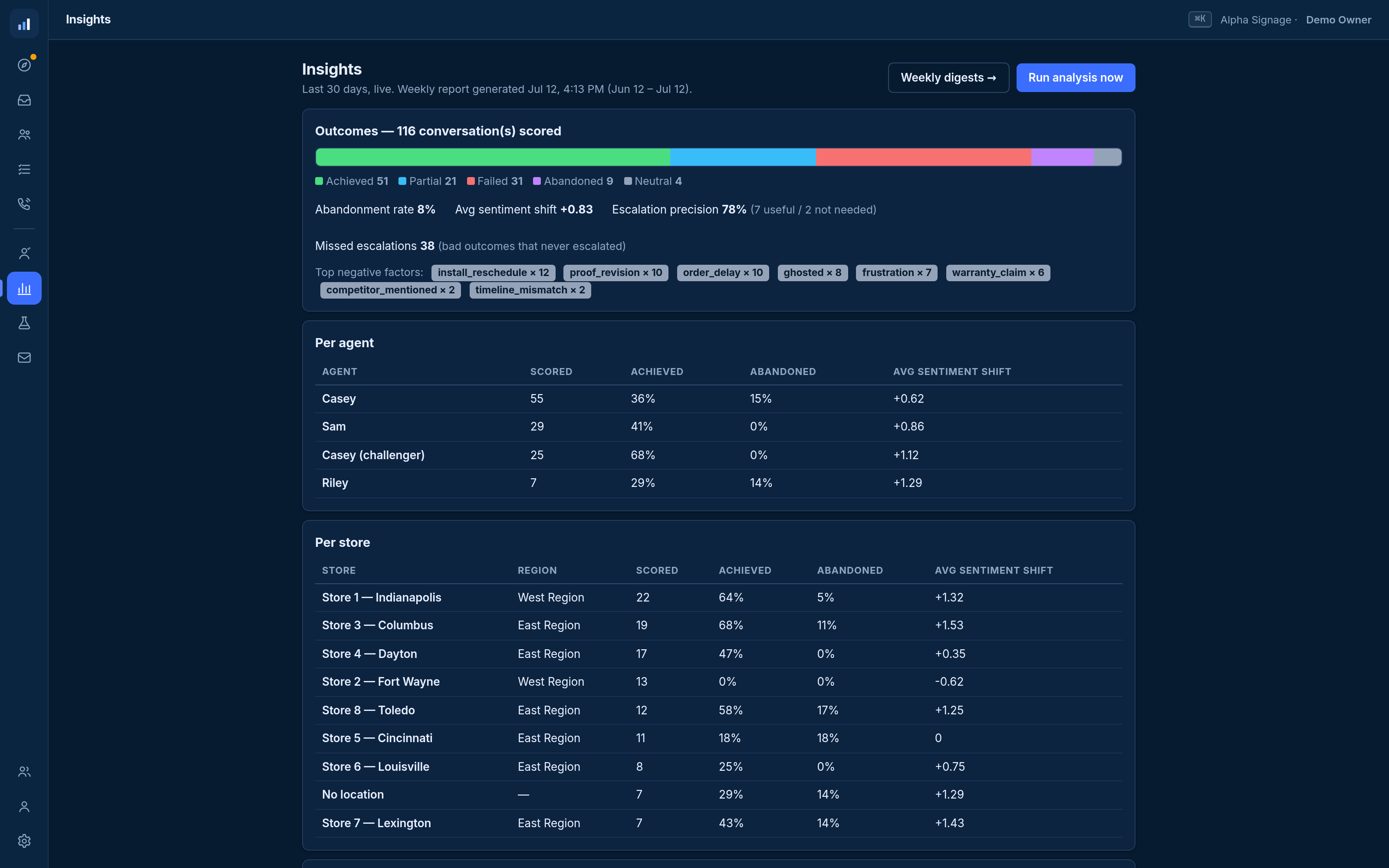
4. Are outcomes measured? Not volume — outcomes. Every settled conversation should be scored against the agent’s actual goal: achieved, partial, failed, or abandoned, with sentiment tracked from first message to last. AttainScale’s insights view adds the two numbers that keep the whole system honest: escalation precision (of the flags your team closed, how many actually needed a human?) and missed escalations (conversations that ended badly with no human ever alerted). If the vendor’s reporting can’t distinguish a resolved customer from one who gave up, neither can you.
Four yeses, demonstrated with mechanisms rather than adjectives, and you’re no longer talking about a dumb agent. That combination — stop, hold, learn, measure — is the entire design brief behind AttainScale; how it works walks the same four answers end to end.
The honest caveat
Even a smart agent is a dumb agent for its first two or three weeks. It hasn’t learned your policies yet; that’s what the ramp is for. A serious deployment starts in review mode — a human approves every reply — while the correction loop absorbs your edits and your escalation types get tuned to your actual risks. Somebody on your team has to own that ramp: reviewing drafts, approving lessons, watching the first insights come in. If nobody can own it, you’re not ready to deploy anything, smart or dumb — and waiting is the correct call. That’s not a hedge; it’s the thesis. The point was never “AI now.” The point is deliberate AI or none.
If you’re weighing a deployment this year, bring us your messiest use case — the location, the channel, the failure you’re most afraid of — and we’ll walk the four questions against it live.
→ Book a 20-minute walkthrough
FAQ
Is it really better to do nothing than to deploy AI?
It’s better than deploying a dumb AI agent — one that can’t distinguish routine from critical, guesses when unsure, can’t be corrected, and reports volume instead of outcomes. Doing nothing keeps failure bounded, visible, and owned by a human. The right move isn’t waiting forever; it’s holding any deployment to that bar.
What makes an AI agent “dumb”?
Architecture, not model quality. The four markers: no concept of stakes (every message treated the same), confident guessing under uncertainty, no path for your team’s corrections to change its behavior, and dashboards that count conversations handled rather than outcomes achieved.
How do I evaluate an AI agent before buying?
Ask four questions and demand demonstrations: Does it know when to stop (typed escalation with per-type behavior)? Does it hold replies it isn’t sure about (confidence gating with a fail-safe)? Do corrections stick (edits becoming approved, permanent lessons)? Are outcomes measured against a goal (including abandonment and escalation precision)?
How long until an AI agent can run unsupervised?
Plan on two to three weeks of supervised ramp: review mode first, then autopilot behind a high confidence threshold, loosened as the weekly autonomy number earns it. Any vendor promising safe full autonomy on day one is describing a bot that guesses.
AttainScale is an AI operating layer for multi-location businesses: one inbox across SMS, email, webchat, and voice, agents that know when to escalate, and a learning loop that makes every correction permanent. See what’s under the hood →