
Here’s a one-question audit for any AI agent you’re running or evaluating. Find a question it can’t actually answer — a price that varies by store, a warranty edge case, a refund that needs a manager’s sign-off — and ask it. There are only two possible responses: it guesses, or it asks. Everything else about the tool is detail. This is the confidence test, and most of what’s sold to multi-location businesses fails it.
Guessing is the signature move of a dumb agent. A human employee who doesn’t know says “let me check on that” — it’s the most natural sentence in customer service. A language model left to its own devices almost never says it. Understanding why, and what it takes mechanically to fix it, is the difference between an agent you can extend real autonomy to and a bot you’ll eventually unplug.
Why LLMs default to the confident answer
It’s not a bug someone forgot to fix; it’s the grain of the material. Language models are trained to produce the most plausible continuation of a conversation, and the most plausible continuation of “how much for a brake job on a 2019 Silverado?” is a price — not an epistemology lecture. Fluency and accuracy are manufactured by the same process, so the model sounds exactly as confident retrieving a fact it has as inventing one it doesn’t. The training that made it helpful also made it allergic to “I don’t know.”
One employee with this trait is a coaching problem. Software with this trait, answering hundreds of conversations a day across every location, is a liability manufacturing line. Each guess about pricing is a discount you didn’t authorize. Each guess about availability is an appointment your store can’t honor. Each guess in a legal-adjacent conversation is discoverable, written, and signed with your brand. And because a guess satisfies the customer in the moment, the damage surfaces days later, at the counter or in a review — we walked through a full post-mortem of exactly that failure last week.
The fix is not a better model. Better models guess more persuasively. The fix is architecture that checks the work before it leaves the building.
What confidence gating means mechanically
“Human in the loop” is a phrase every vendor now uses, so here is precisely what it means in AttainScale — mechanism by mechanism, so you can hold any tool to the same standard.
A judge scores every autonomous reply. When the account runs in autopilot, every reply the agent wants to send is first scored 0–100 by a separate, fast LLM judge. The judge isn’t grading grammar; it’s briefed on the failure modes that actually hurt you — it scores low when the draft guesses at facts, promises anything uncertain (prices, refunds, availability, anything in legal territory), mishandles an upset customer, or contradicts the conversation so far.
You set the threshold. The autopilot confidence threshold is a dial from 0 to 100. A reply scoring at or above it sends, with the score recorded. Below it, the reply doesn’t send — it’s held for review, appearing in your inbox with an amber chip: HELD: low confidence (42), along with the judge’s reason. Your manager reads the draft, and sends it, edits it, or rejects it. Nothing was ever at risk; the customer just got a human-checked answer a few minutes later.
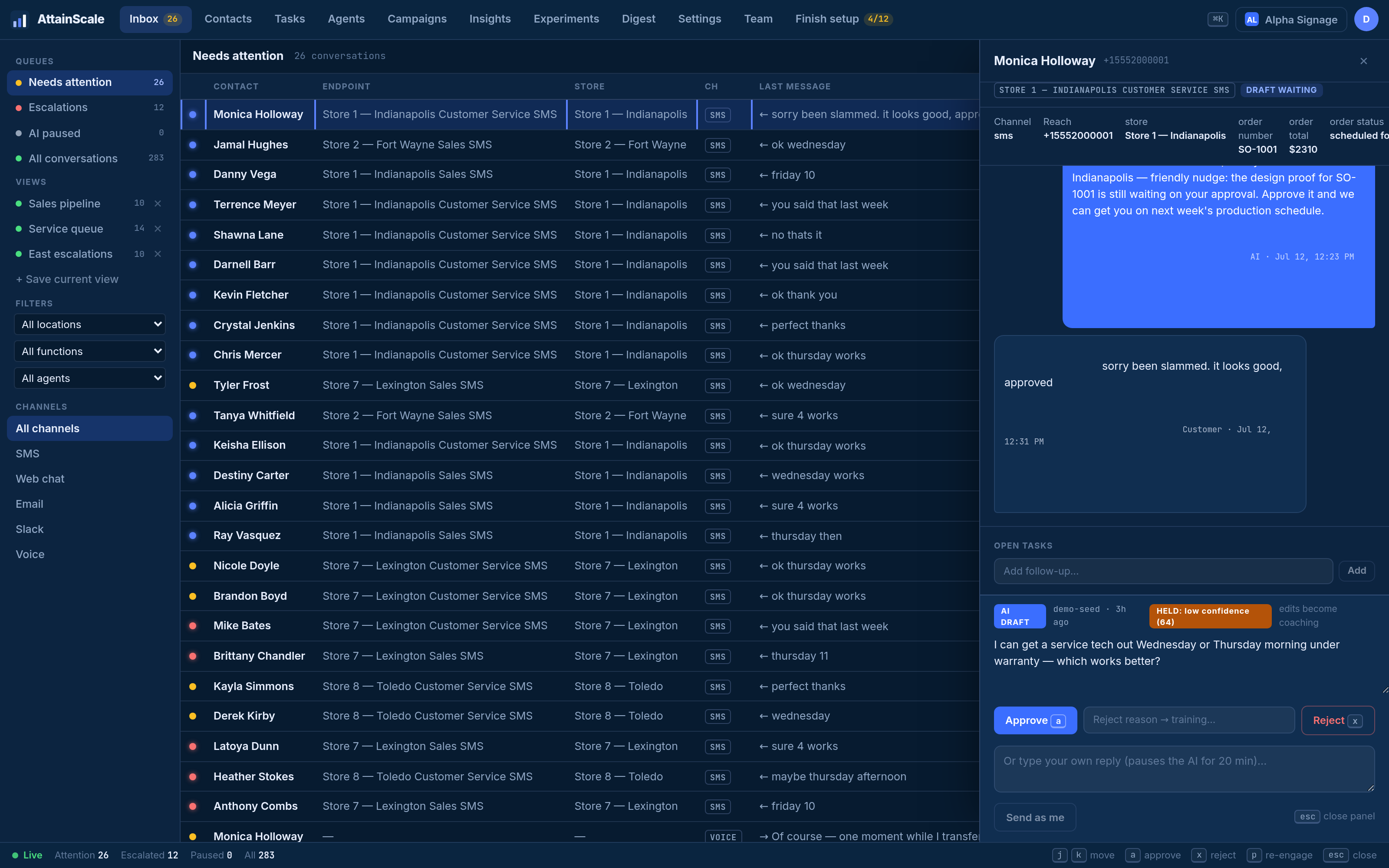
Held drafts feed the learning loop. This is the part that makes the gate more than a safety net. An edit or a rejection with a reason is training data: it’s distilled overnight into a proposed lesson, and once approved, the correction applies to every agent on every channel. The gate doesn’t just catch today’s guess — it’s the intake valve for making tomorrow’s agent guess less. (The full loop gets its own post: the learning loop.)
The gate fails safe. The question nobody asks in the demo: what happens when the judge itself errors out or times out? In AttainScale, the reply is held with confidence check unavailable. When the system can’t verify its own confidence, it behaves as if confidence were zero. A gate that waves traffic through when the guard booth loses power is not a gate.
Some conversations bypass the dial entirely. Confidence gating handles uncertainty; it doesn’t handle stakes. A message that trips a suppress-type escalation — a legal threat, say — holds for a human in every mode, at any threshold. The judge decides how sure the agent is; escalation types decide whether the agent should be answering at all. You want both layers, because a bot can be perfectly confident about something it should never say.
The trust ramp: autonomy as an earned number
The threshold dial turns “do we trust the AI?” from a leap of faith into a rollout plan. The pattern we recommend to every operator:
- Weeks 1–2: review mode. A human approves every reply. This feels slow and is supposed to — every edit you make is teaching the system your policies. (Why the first messages barely need this scrutiny is the 5% Rule; the ramp is how you prove it on your own traffic.)
- Week 3: autopilot, threshold 80. Only replies the judge scores 80+ go out alone. In practice that’s the routine bulk — hours, status, scheduling — while anything with a whiff of ambiguity still lands in the review queue.
- Then: walk the dial down as the number earns it. Every Monday, the digest reports % fully autonomous — and it’s an honest number, because a reply only counts as autonomous if no human touched it. A held-then-approved draft counts as human-gatekept even though the AI wrote every word. You can’t game it, which means you can actually govern with it.
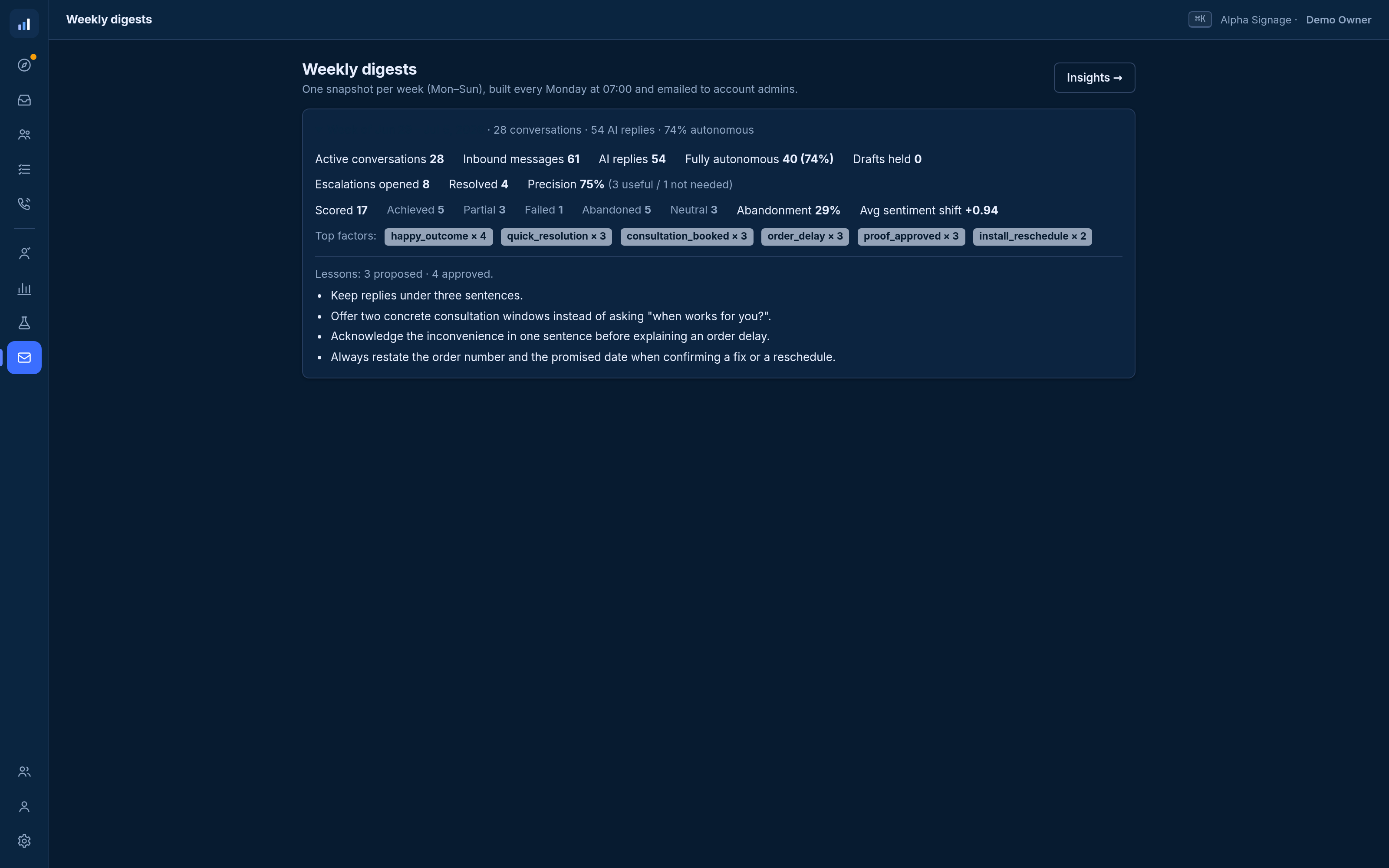
Autonomy stops being a checkbox and becomes a metric with a trend line: 40% autonomous in week three, 60% by week six, climbing as lessons accumulate and held drafts get rarer. When your ops director asks “how much is the AI doing on its own, and should we let it do more?” — that’s a data question now, with a number attached and a dial to move.
Contrast: the bot-on/bot-off tools
Most tools in this market give you a binary: bot on, or bot off. Bot-on means every reply — the confident ones and the guesses — goes straight to customers, and you find out about the bad ones from the counter. Bot-off means a human reads everything, which is the triage pile you were trying to escape. So operators oscillate: switch it on, get burned, switch it off, drown, repeat — and this is how you end up worse off than you started, paying for the tool and the cleanup at once. It’s the pattern behind the thesis of this whole series: deploying a dumb AI agent is worse than doing nothing, and “dumb” here means specifically that it would rather guess than ask.
A binary switch can’t earn trust, because trust is a quantity and a switch has no positions between zero and everything. The dial — judge, threshold, held drafts, fail-safe, an ungameable autonomy number — is what earning trust looks like when it’s implemented rather than promised. It’s one piece of a larger architecture; the features page shows where the gate sits among the escalation, learning, and measurement layers.
The honest caveat
Confidence gating costs you something: held drafts wait for a human, so some customers get answers in minutes instead of seconds, and your team spends real time in the review queue — especially in the early weeks, when the threshold is high and the lessons are few. That’s the deal. You’re trading a little latency on ambiguous messages for never having to explain a confident wrong answer about warranty coverage. We think it’s the best trade in the product, but it is a trade, and a vendor who claims you can have full autonomy with zero review time on day one is describing a bot that guesses.
Want to see the gate work on your hardest questions? Bring three of them — the ones your own staff has to look up — and we’ll run them live.
→ Book a 20-minute walkthrough
FAQ
Why do AI chatbots make up answers?
Language models are trained to produce the most plausible continuation of a conversation, and a plausible answer is usually a specific one — not “I don’t know.” Fluency and accuracy come from the same process, so the model sounds equally confident either way. It’s the grain of the technology, which is why the fix is architectural (a confidence gate), not a better model.
What is confidence gating in AI customer service?
A separate judge scores every AI reply (0–100) before it sends, briefed to score low on guessed facts, uncertain promises, and mishandled upset customers. Replies below your threshold are held for human review with the reason shown; if the judge itself is unavailable, replies hold anyway. The threshold is a dial you loosen as trust is earned.
How is that different from just reviewing everything?
Review-everything doesn’t scale and defeats the point of automation. The gate splits traffic by risk: high-confidence routine replies (the large majority) send instantly, while ambiguous ones wait for a human. Over time, corrections from the review queue become lessons, held drafts get rarer, and the autonomous share climbs.
How do I measure whether my AI agent is trustworthy?
Track the percentage of replies sent with no human involvement — counted honestly, so a held-then-approved draft is credited to the human, not the bot. Paired with outcome scoring and escalation precision, it turns “do we trust it?” into a weekly number with a trend, instead of a feeling.
AttainScale is an AI operating layer for multi-location businesses: one inbox across SMS, email, webchat, and voice, agents that know when to escalate, and a learning loop that makes every correction permanent. This post is part of a series — start with why a dumb AI agent is worse than doing nothing.