
Ask one question about any AI agent you’re considering: will the day-30 version be better than the day-1 version — and can anyone show you the mechanism?
For most tools sold to multi-location businesses, the honest answer is no. The bot you unbox is the bot you’ll have in March: same answers, same blind spots, same mistakes, minus whatever patience your customers and staff started with. A new employee who was exactly as good in month six as on their first morning — who retained no correction, absorbed no policy, learned no customer — wouldn’t survive a performance review. That’s the standard product in this category.
This series opened with a hard claim — deploying a dumb AI agent is worse than doing nothing — and spent four posts on what “dumb” costs: the deployments that die of missing organs, the bots that guess, the dashboards that hide the damage. This post is the other half: the mechanism that separates an AI employee from an AI liability. It’s called the learning loop, and it’s the reason our company exists.
One correction, end to end
Follow a single fix through the system, because the loop is easiest to believe at ground level.
Tuesday, 2 PM: a customer texts store 4 asking to split a payment across two cards. The agent drafts a cheerful “no problem!” — but company policy only allows split payments over $500. Your manager catches it in the inbox and edits the draft before it sends: “We can do that on invoices over $500 — yours qualifies, so yes.” Thirty seconds of her day. In a static tool, that’s where the story ends: one message fixed, system unchanged, same wrong draft next Tuesday.
Here, the edit is training data. Overnight, a distillation pass reads the batch of human feedback — every edited draft, every rejection with its reason — and looks for patterns. It deliberately waits for at least three pieces of corroborating feedback, so one manager’s one-off phrasing preference doesn’t become company law. When the pattern is real, it writes a proposed lesson: a short rule — “Split payments are only available on invoices over $500; confirm the amount before agreeing” — with the evidence attached.
Wednesday, 8 AM: the proposal is waiting in the approval queue. Your manager reads it, recognizes her own correction generalized, and clicks Approve. From the very next reply onward, that lesson is part of the working instructions of every agent, on every channel, at every location — SMS, email, webchat, and the phone agent, whose prompt re-syncs to the voice provider automatically. One edit, one click, and a policy that used to live in one manager’s head is now enforced at store 1 through store 12, around the clock.
That’s the loop at its smallest: act → correct → distill → approve → deploy. The rest of this post is what happens when you keep turning it.
Why the approval gate is the point, not the friction
Notice what did not happen in that story: the machine never changed its own behavior. The distillation pass can propose; only a human can teach. Every lesson — whether it came from draft edits, a coached conversation, a rough voice call, or the weekly analytics run — lands in the same queue, as proposed, with its evidence, and waits for a click.
This is a deliberate answer to the fear every operator has about “self-learning AI,” and the fear is correct: a system that silently rewrites its own rules from noisy feedback will eventually learn something you’d never have signed off on — from a sarcastic customer, a bad day, a misread pattern. The gate means the learning is real but the governance is human: nothing machine-generated ships silently, everything is auditable, and a bad proposal costs you one click to dismiss (and it won’t be re-proposed). Reviewing the week’s lessons takes a manager minutes on Monday. That’s the entire cost of making “the AI taught itself” impossible at your company.
Coach chat: interview your best manager
Waiting for mistakes is the slow way to train. The faster way: your best people already know the policies, the exceptions, and the phrases that de-escalate a heated customer — so the playground’s coach mode lets them transfer it directly. Your manager talks to the agent the way she’d brief a new hire: “When someone asks about warranty coverage, never confirm until you know the part and mileage. And stop apologizing three times per message — once, then fix the problem.” Click Apply training, and the conversation is distilled into proposed lessons that land in the same approval queue as everything else.
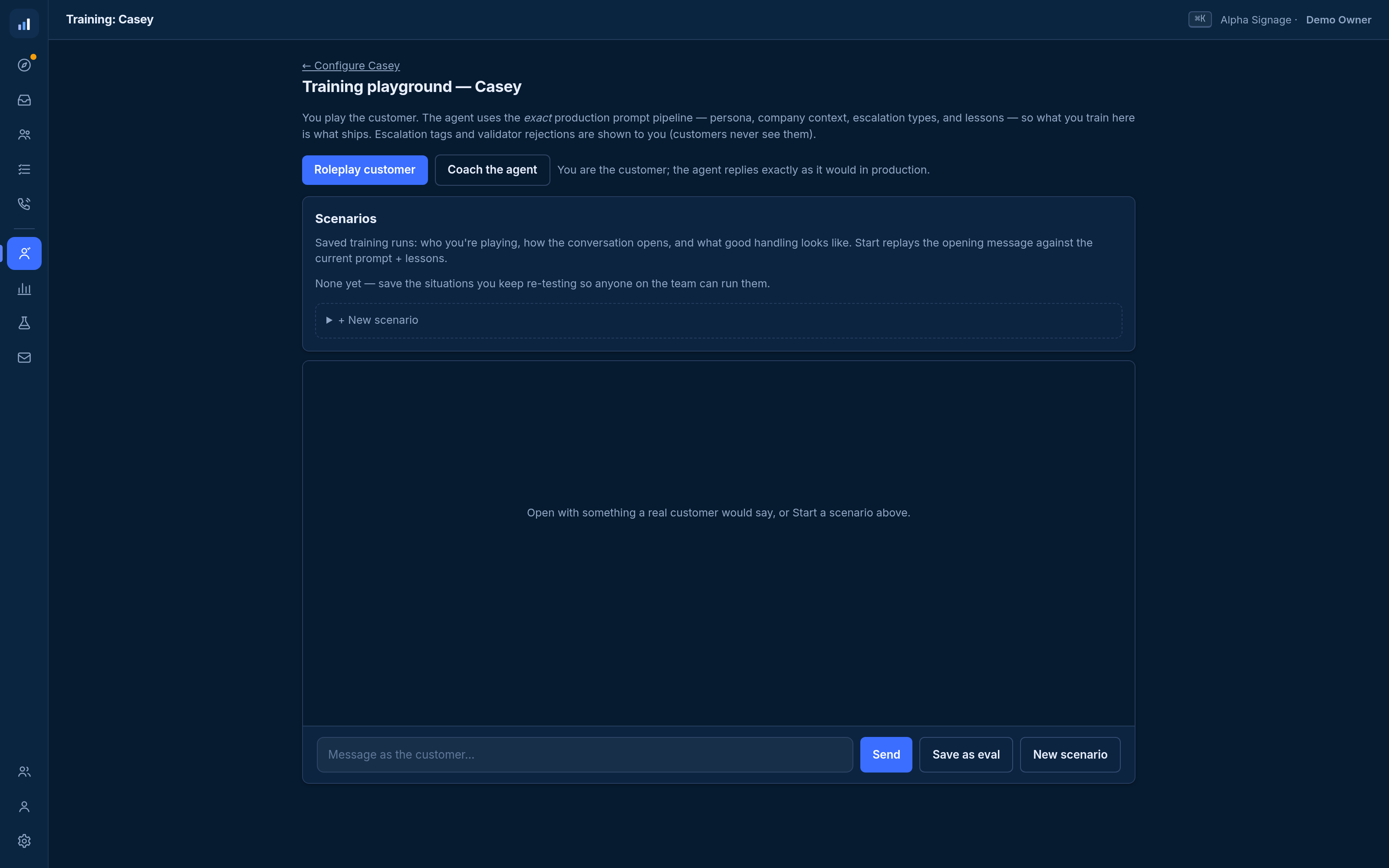
Think about what this means for the knowledge that walks out the door when a twenty-year service manager retires. An hour of coach conversations turns the contents of her head into reviewed, permanent, every-location policy. No tool with a vendor-ticket “retraining process” can do anything in this paragraph.
Evals: the regression suite for judgment
A system that changes weekly needs what software teams have had for decades: regression tests. Any playground conversation worth locking in can be saved as an eval case — a real transcript with assertions attached: this reply must raise the threat/legal escalation; it must contain “over $500”; it must never contain a coverage confirmation. Run them all after any prompt edit, lesson change, or model swap, and the runner replays every case through the live pipeline — current persona, current lessons — and tells you either “all cases passed, safe to ship” or exactly which behavior broke. The command-line version exits red so it can block a deploy outright.
The workflow that scales: every real-world miss becomes a playground reproduction, a coached fix, and a saved eval. Your test suite grows out of your actual failures — the ones that happen to your business — so the agent can never quietly regress on a mistake it already made once.
Experiments: when you’d rather measure than trust
The loop’s final maturity stage answers the question every operator eventually asks: “how do I know that training change actually helped?” The answer is a controlled test. An experiment clones your agent, gives the clone exactly one new lesson — one variable, so a win is attributable — and splits live traffic between champion and challenger. The split is sticky by customer, so nobody experiences a mid-thread personality change. Before the challenger meets a single customer, it must pass the champion’s entire eval suite; a “better opener” that also breaks your refund policy is discarded at the gate.
Then the scoring engine — the same one behind the outcome metrics we covered last week — grades both arms on real conversations, and a two-proportion z-test decides when the difference is statistically significant rather than a good week. Win, and one click promotes the challenger’s lesson to your real agent. Lose or inconclusive, dismiss, and the champion never felt a thing. The weekly insights run will even propose experiments itself when it spots a pattern worth testing — and like everything machine-proposed, the experiment waits for your approval before touching traffic.
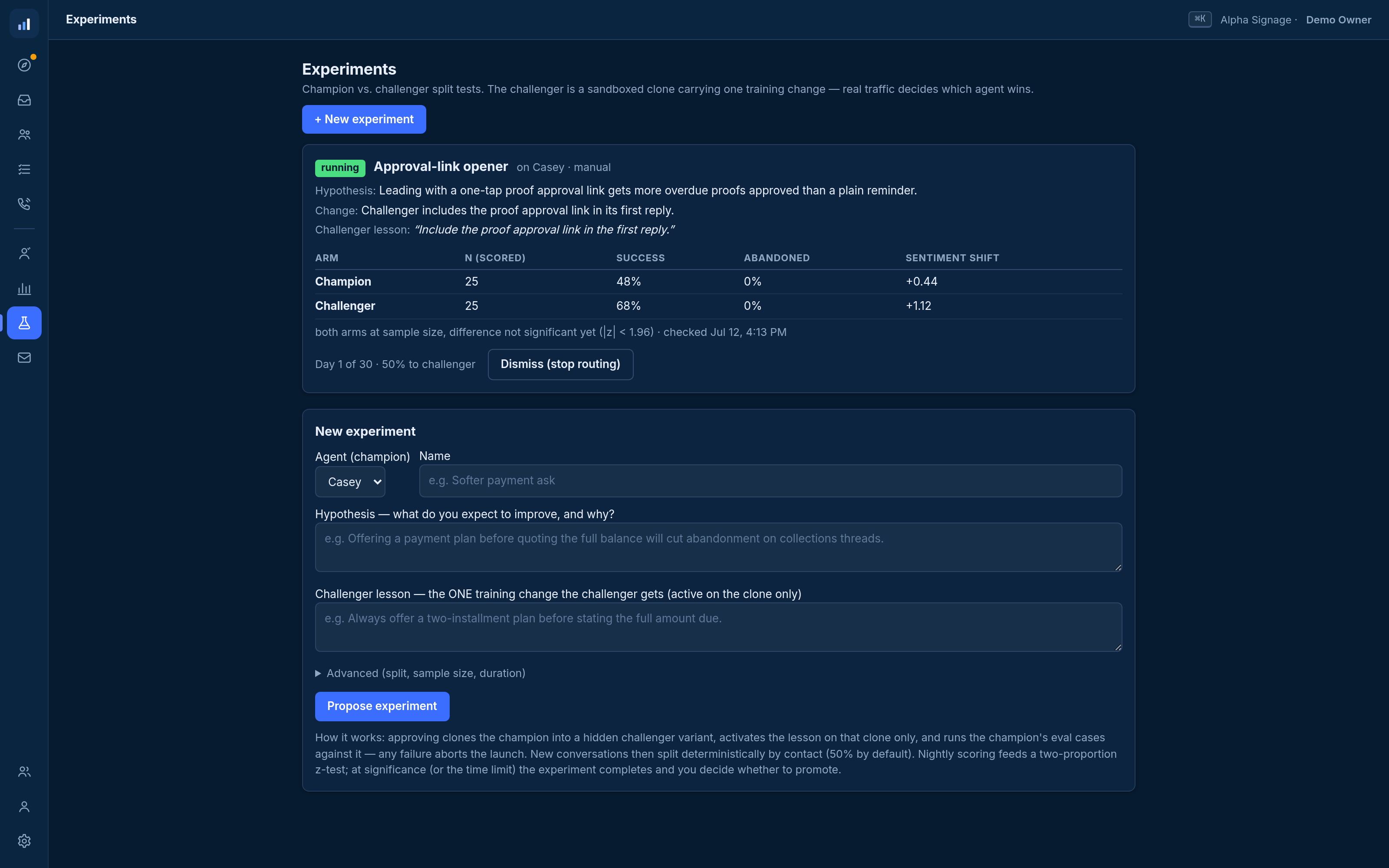
Prompt tweaks stop being vibes. “I think the new greeting is working” becomes “challenger: 68% success vs 52%, z = 2.1, promoted Tuesday.”
The compounding math
Now zoom out to why month six beats month one, structurally. Each turn of the loop produces an asset that does not depreciate: an approved lesson stays in every future reply; a saved eval guards its behavior forever; a promoted experiment locks in a measured gain; every correction makes held-for-review drafts rarer, which raises the autonomy percentage, which frees your team to spend review time on the genuinely hard cases — the 5% that were always the point.
A static bot’s trajectory is flat at best — day-30 equals day-1, while customer patience and staff trust drain. A learning system’s trajectory is a staircase: dozens of approved lessons by month three, an eval suite grown from your real edge cases, two or three promoted experiments, autonomy earned percentage point by percentage point. And the gap between those two lines widens every week you operate, which reframes the whole falling-behind-on-AI anxiety. The risk was never that competitors bought software before you did. It’s that one of them started compounding corrections six months before you did — and that lead, unlike a software purchase, can’t be caught up with a credit card.
The honest caveat
The loop doesn’t run itself. It compounds exactly as fast as your team feeds it: edits and rejections in the early weeks, a few minutes of lesson approvals on Mondays, the occasional coach session after a bad thread. Plan on two to three supervised weeks before the curve visibly bends, and expect the first month’s digest to show more “held for review” than autonomy. A business where nobody will own that rhythm won’t get compounding — it’ll get a well-architected tool used like a dumb one. The loop is a flywheel, and flywheels need someone to push first.
The only kind worth deploying
Five posts ago this series started with a warning, so it should end with the warning inverted. A dumb agent — no escalation judgment, no correction path, no outcome measurement — is worse than doing nothing, and we stand by every word. But the inverse is just as true: an agent that learns — visibly, governably, with your people holding the approval key — is the only kind worth deploying, and it’s worth deploying soon, because the asset it builds is time-based and yours alone. Every correction your managers make from now on either evaporates into a vendor ticket or compounds into an operating advantage. The mechanism for the second option is what we build; the features page lays out every stage of the loop.
The best way to evaluate a learning loop is to watch it learn. Bring one real policy from your business — a rule your current tools can’t enforce — and we’ll take it from correction to proposed lesson to every-channel deployment in front of you.
→ Book a 20-minute walkthrough
FAQ
What is a learning loop in AI customer service?
The cycle that turns human corrections into permanent agent behavior: the agent acts, your team corrects (edited drafts, rejections, coach conversations), the corrections are distilled into proposed lessons, a manager approves them, and the approved lessons deploy to every agent on every channel — then outcome scoring measures whether behavior actually improved.
Does the AI change its own behavior automatically?
No — that’s the design’s central guarantee. Machine-generated lessons always land as proposals awaiting human approval. The one sanctioned exception is sandboxed: an experiment’s challenger lesson runs only on the challenger clone, and reaches your real agent only if it wins the test and a human clicks promote.
How long does it take an AI agent to learn a business’s policies?
The first corrections become live lessons within a day of approval. Expect two to three supervised weeks before autonomy meaningfully climbs, a useful lesson library within the first month, and compounding returns after that — the day-30 agent should be measurably better than day-1, and month six better still.
How do I know a training change didn’t make things worse?
Two mechanisms: eval cases (saved conversations with assertions, replayed after every change — a red case blocks the change) and A/B experiments (a cloned challenger with exactly one new lesson, graded on live outcomes, promoted only on a statistically significant win).
AttainScale is an AI operating layer for multi-location businesses: one inbox across SMS, email, webchat, and voice, agents that know when to escalate, and a learning loop that makes every correction permanent. This post closes the series that began with why a dumb AI agent is worse than doing nothing.