
Two multi-location businesses each deployed an AI agent six months ago. At the first, the agent has quietly become the best hire of the year: customers get correct answers in seconds, the risky conversations reach managers early, and the thing gets measurably better every week. At the second, the agent has been promising warranty coverage that doesn’t exist and annoying customers into silence, and the staff has learned to route around it.
Both dashboards say the same thing: “10,000 conversations handled.”
That’s the problem with volume metrics, stated as plainly as we can: they describe a compounding asset and a liability factory in identical language. You literally cannot tell a smart agent from a dumb one on a volume dashboard — and if you’ve read this series’ opener on why deploying a dumb AI agent is worse than doing nothing, you know which of those two operators is in more danger. Hint: it’s not the one lying awake at night. It’s the one sleeping soundly on the wrong numbers.
The vanity stack
Three metrics dominate AI-agent reporting, and each one measures activity while implying achievement.
Conversations handled. “Handled” means the software emitted replies. The customer who got a wrong answer was handled. The customer who asked three times and gave up was handled. It’s the odometer on a car that might be driving to the wrong city.
Deflection rate. The share of conversations that never reached a human — reported as if “never reached a human” were the goal. But deflection can’t distinguish its two components: customers who didn’t need a human, and customers who needed one and didn’t get one. The second group isn’t a success; it’s your churn pipeline. A deflection number that goes up when frustrated customers quit asking is a metric with its incentives installed backwards.
Average response time. Four seconds instead of four hours is genuinely valuable — for correct answers. For wrong ones, speed is an accelerant. A dumb agent doesn’t fix your response-time problem; it gives your mistakes your response-time advantage.
None of these numbers are false. They’re just answers to “is the software running?” dressed up as answers to “is the business better off?” A vendor who reports only these three is grading their own homework with a rubric that can’t produce a failing grade.
The accountability stack
Here’s what reporting looks like when it’s built to answer the operator’s question instead of the vendor’s. Five metrics, each with a precise definition, because vague metrics are how vanity sneaks back in.
1. Outcome versus goal. Every agent should have a stated goal — “book the service appointment,” “collect payment or a firm promise-to-pay date” — and every settled conversation should be scored against it. In AttainScale, a judge reads each finished transcript and records one of five outcomes: achieved, partial, failed, abandoned, or neutral. Now “10,000 conversations handled” decomposes into something you can manage: how many achieved the goal, how many failed, and — the number that changes behavior — how many customers walked away mid-thread.
2. Sentiment trajectory. Not a snapshot — a delta. Scoring records the customer’s mood at the start and end of every conversation (−2 to +2) and reports the average shift. An agent can be unfailingly polite while conversations consistently end colder than they began; a snapshot hides that, a trajectory doesn’t. Positive shift means conversations leave customers better than they arrived. That’s the entire job, in one signed number.
3. Abandonment — the silent killer. This metric deserves its own paragraph, because it’s where dumb agents hide their damage. An abandoned conversation is one where the customer went silent with the issue unresolved: they asked, got something useless, maybe tried once more, and left. No complaint, no escalation, no signal — on a volume dashboard it’s indistinguishable from a satisfied customer who simply stopped replying, and on a deflection dashboard it counts as a win. Abandonment is measured churn-in-progress. If you adopt one metric from this post, adopt this one, and be suspicious of any tool that can’t produce it.
4. Escalation precision — and its inverse. When the agent flags a human, was the flag worth it? Every escalation your team closes in AttainScale is marked either resolved (a human was genuinely needed) or not needed — and precision is simply useful flags divided by total flags. Low precision means your team is wading through false alarms; the fix is tightening escalation triggers, and now you know. The inverse number matters just as much: missed escalations — conversations that ended badly with no human ever alerted. That’s the recall check, and it’s exactly the gauge that was dark in every “we turned the chatbot off” story.
5. Percent autonomous — counted honestly. What share of AI replies went out with no human gatekeeper? The definition has to be strict or the number is theater: in AttainScale, a reply only counts as autonomous when no approving user touched it. A draft the confidence gate held and a manager released counts as human-gatekept, even though the AI wrote every word. Defined that way, the number can’t be gamed — and watching it climb from 40% to 70% over a quarter is the trust ramp made visible.
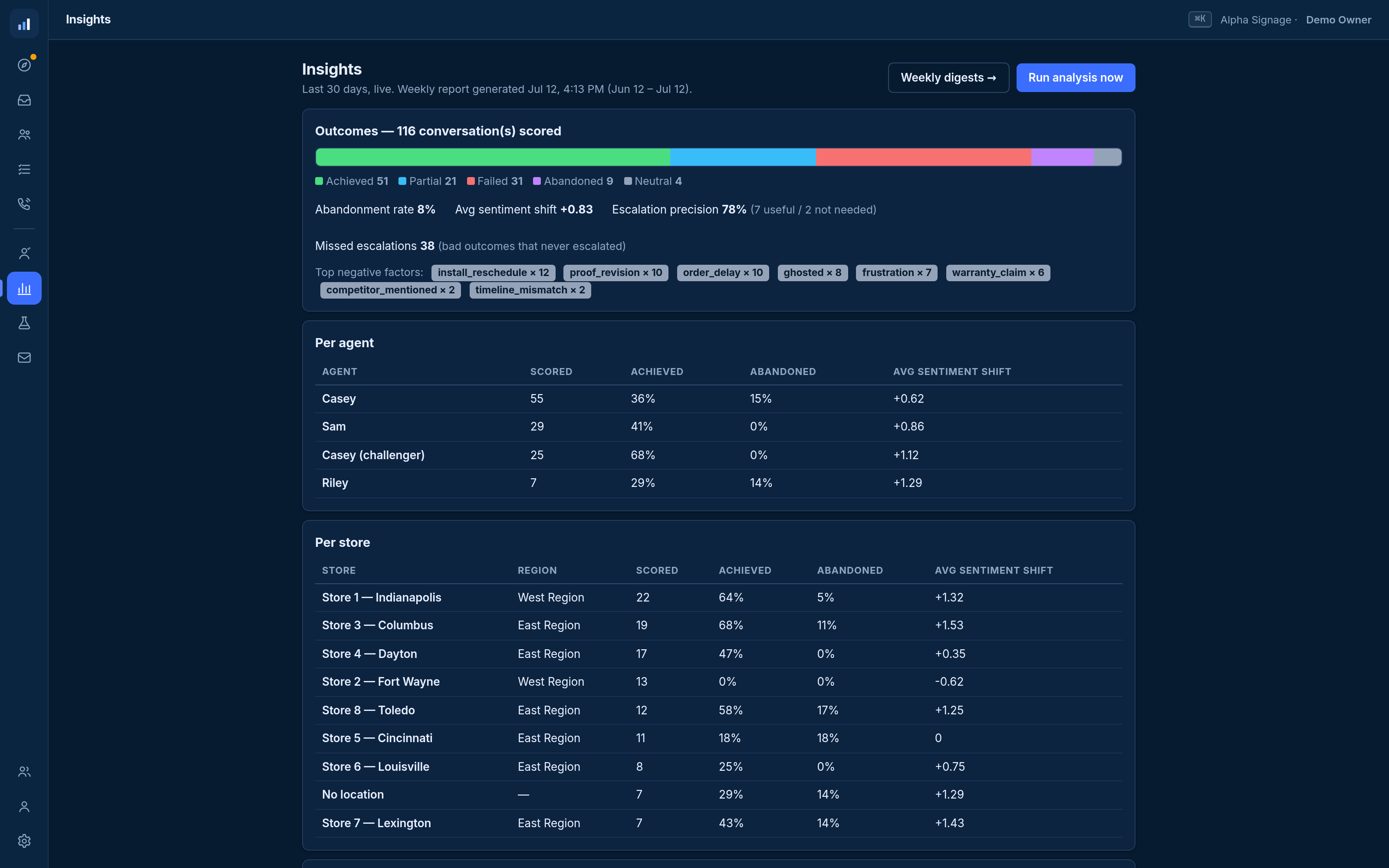
All five live on one screen in AttainScale’s insights view, sliced per agent and per store — so “store 6’s abandonment is double the chain’s” is a sentence your Monday meeting can start with. The dashboard also lists the ten worst recent conversations, linked, because an aggregate you can’t drill into is just vanity with decimals.
The test, applied
Go back to the two operators from the opening. On the accountability stack, they stop being twins immediately. The smart agent: 61% achieved, abandonment at 9% and falling, sentiment shift +0.4, escalation precision 78%, autonomy climbing week over week. The dumb one: abandonment at 30% and invisible until now, sentiment shift negative, missed escalations stacking up — every warranty blowup was sitting in a “failed, never escalated” row nobody could see.
Same volume. Same response time. Same “10,000 handled.” Five numbers apart. That’s the whole argument: smart and dumb agents are indistinguishable on volume and instantly distinguishable on outcomes — which is why vendors selling dumb ones report volume.
What weekly reporting should look like
You shouldn’t need to open a dashboard to stay honest. Every Monday at 7 AM, AttainScale emails account admins a digest of the week: activity counts, drafts held for review, % fully autonomous, escalations opened and resolved with precision, the outcome snapshot with top negative factors — and a closing section volume dashboards would never think to include: what your agents learned, listing the lessons proposed and approved that week. An agent that learned nothing for three straight weeks is a flag worth catching, and this is the report that catches it.
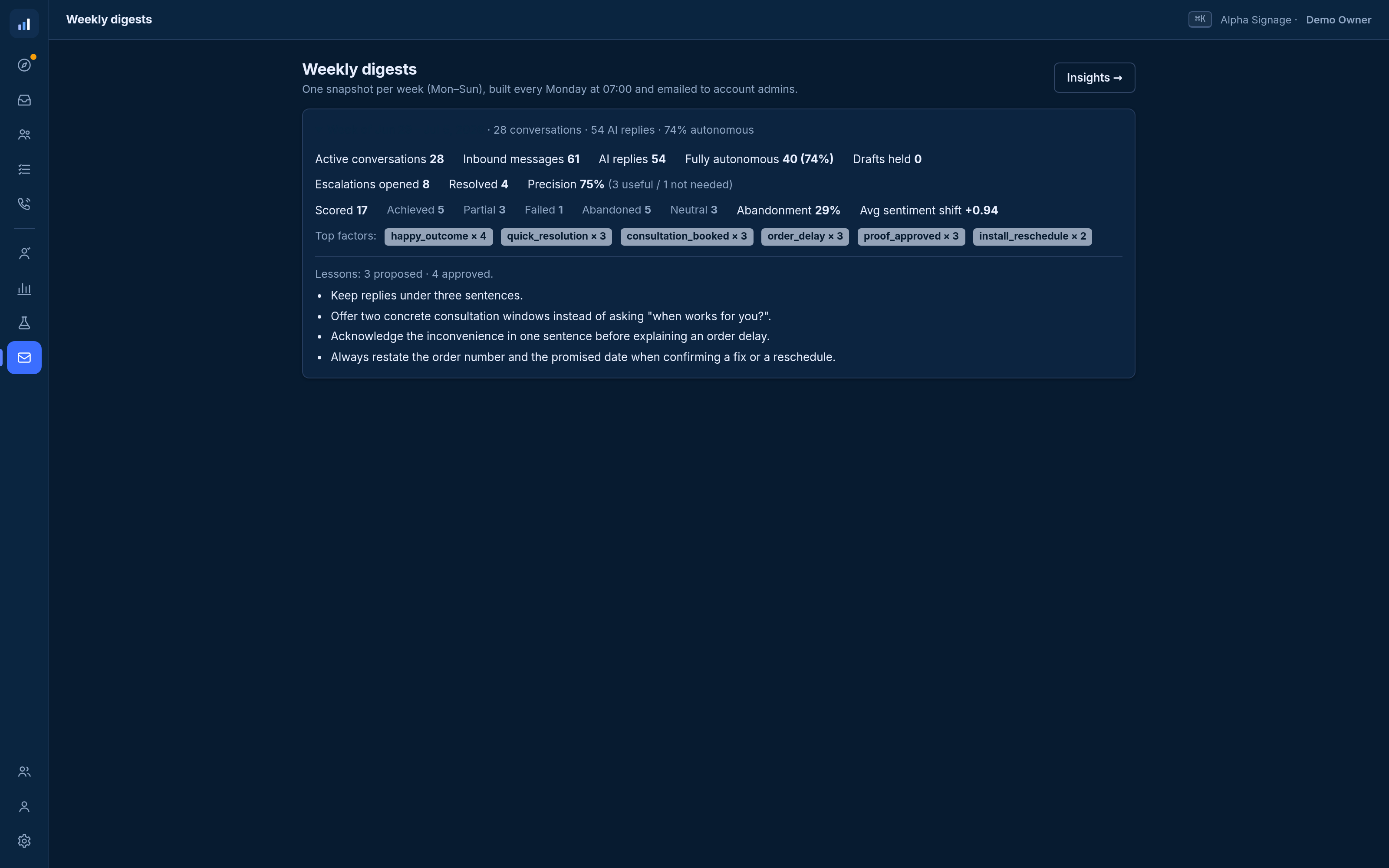
Ten minutes with that email and you know whether the AI helped or hurt last week — which is the question the $0.99-per-“resolution” crowd would prefer you never operationalize. The measurement layer is half of what makes the system trustworthy; how it works shows where scoring sits in the pipeline, between the conversations and the learning loop they feed. And these numbers only exist because the agent’s replies, escalations, and goals all run through one system — the reason humans can spend their time on the messages that matter, per the 5% Rule.
The honest caveat
Outcome scoring is judgment, not arithmetic — an LLM judge reads transcripts against a goal, and it will occasionally misread one. Two design choices keep that honest: every score carries the judge’s own confidence, and the worst-conversations list links straight to the transcripts, so you can audit the grader against reality any time. Directionally, across hundreds of conversations, the trends are solid; treat any single conversation’s score as a claim you can check, not a verdict. Also true: these numbers need volume to mean anything. A store scoring 12 conversations a month will see noisy percentages — read the trend, not the week.
Curious what your own outcome mix looks like? Bring last month’s “conversations handled” number and we’ll show you, live on a seeded account for a business like yours, what the same volume looks like through the accountability stack.
→ Book a 20-minute walkthrough
FAQ
What KPIs should I use to measure an AI chatbot or agent?
Five outcome-based metrics: conversations scored against the agent’s stated goal (achieved/partial/failed/abandoned), sentiment trajectory (end minus start, not a snapshot), abandonment rate, escalation precision plus missed escalations, and percent of replies sent with no human gatekeeper. Volume metrics — handled, deflected, response time — measure activity, not results.
Why is deflection rate a misleading metric?
Deflection lumps together customers who didn’t need a human and customers who needed one and gave up. The second group counts as “success” while actually being churn in progress. Abandonment tracking — customers who went silent with issues unresolved — is the corrective.
What is conversation abandonment and why does it matter?
An abandoned conversation is one the customer left with their issue unresolved — no complaint, no escalation, just silence. It’s the primary way bad AI agents hide damage, because on volume and deflection dashboards abandoned customers look identical to satisfied ones. It should be a first-class metric with its own trend line.
How often should I review AI agent performance?
A weekly rhythm works: one Monday digest with autonomy, precision, outcomes, and what the agents learned, plus a monthly look at per-store trends. Daily dashboard-watching isn’t required once escalations and held drafts are routing to humans in real time — the exceptions come to you.
AttainScale is an AI operating layer for multi-location businesses: one inbox across SMS, email, webchat, and voice, agents that know when to escalate, and a learning loop that makes every correction permanent. This post is part of a series — start with why a dumb AI agent is worse than doing nothing.